
Authors: Michael Grantmyre and Ryan Unruch
Convertible securities intelligence
Total Convertible Securities financings, by number of deals and dollars raised – by quarter
For convertible securities financings captured by the Deal Points Report, the charts below show the total number of such convertible securities financings and the aggregate dollars raised in such financings during 2024–2025, by quarter and by security type (SAFE or convertible promissory note).
In 2025, SAFEs continued to represent the most common form of convertible security across all financings, accounting for 51.8% of all convertible securities issued, while convertible promissory notes represented 48.2% – it is important to note that these percentages are blended across all stages of financing, and a deeper dive into the data shows that SAFEs were predominantly early-stage fundraising tools, whereas convertible promissory notes were more common in later-stage financings.
Measured by dollars invested, the pattern reverses. In 2025, SAFEs accounted for 31.7% of total capital invested (compared to 11.6% in 2024), while convertible promissory notes accounted for 68.3% (compared to 88.4% in 2024). This divergence is consistent with the observation above: companies issuing convertible securities in later-stage financings, which typically result in the investment of larger amounts of capital, more frequently utilize convertible promissory notes, while earlier-stage financings, which typically result in the investment of smaller amounts of capital, continue to rely on SAFEs.
Number of Convertible Financings by Quarter – 2024 – 2025
DP2025-52
Dollars Invested by Convertible Instrument by Quarter – 2024-2025
DP2025-53
SAFE vs Convertible Promissory Note by Industry
In 2025, SAFEs dominated investment in the AI, Information Technology and Fintech industries, accounting for 73.3%, 53.3% and 75.0%, respectively, of convertible securities used in these financings. However, data from the Deal Points Report shows that the Health/Life Sciences and Cleantech industries, in particular, exhibited a higher incidence of convertible promissory note usage, with 54.5% and 82.4%, respectively, of convertible securities financings in these industries in 2025 structured as convertible promissory notes.
This aligns with expectations, particularly where companies in these industries are capital intensive and have longer-term investment horizons, often necessitating more structured investment instruments.
DP2025-54
Pre-Money vs. Post-Money Valuations Cap Convertible Securities
Post-money SAFEs continued to dominate in 2025, representing 90.7% of all SAFEs issued in the data captured by the Deal Points Report, up from 81.2% in 2024. This trend reflects the continued adoption of the Y Combinator post-money SAFE structure, which provides greater certainty around dilution for both founders and investors. For convertible promissory notes, the preference for post-money structures also increased in 2025, with 64.9% of convertible promissory notes using a post-money structure compared to 52.2% in 2024. This suggests a continued convergence in market practice, with convertible promissory note terms increasingly aligning with the post-money economics that are now standard in SAFEs.
DP2025-55
DP2025-56
Convertible Securities Amendment Thresholds
The chart below indicates where SAFEs and Convertible promissory notes issued as part of a financing required all holders to agree to amendments to these convertible securities or whether only a majority of holders was instead required. In 2025, the prevalence of majority amendment thresholds increased for both SAFEs (89.8% compared to 85.9% in 2024) and convertible promissory notes (86.4% compared to 74.6% in 2024), reflecting a continued shift away from all-holder consent.
In practice, these amendment thresholds allow for holders representing a majority of the aggregate purchase amount(in the case of SAFEs) or principal and accrued interest amounts (in the case of convertible promissory notes) to approve amendments on behalf of all holders of the same series. This structure prevents individual investors from having an effective veto over amendments to a given issuance, while still requiring broad holder consensus and improving administrative efficiency.
DP2025-57
DP2025-58
Valuation Caps and Discounts
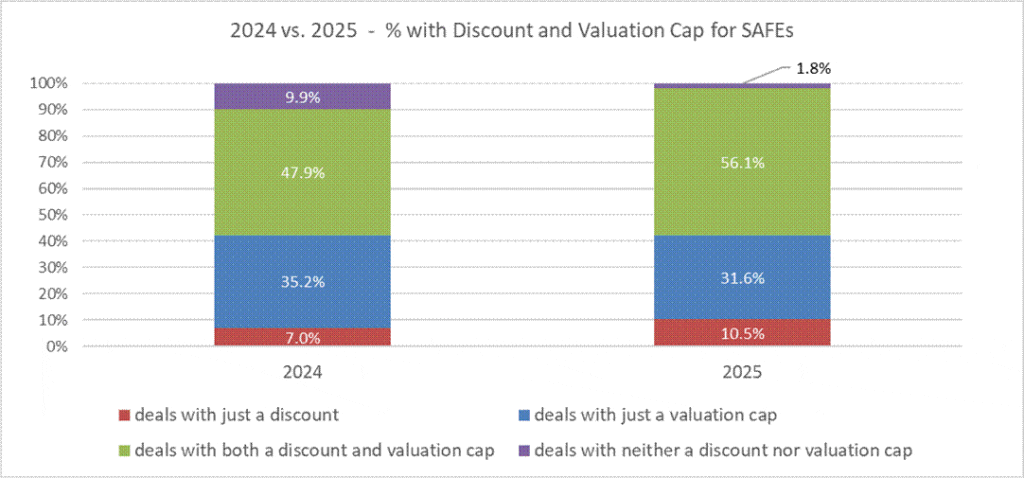
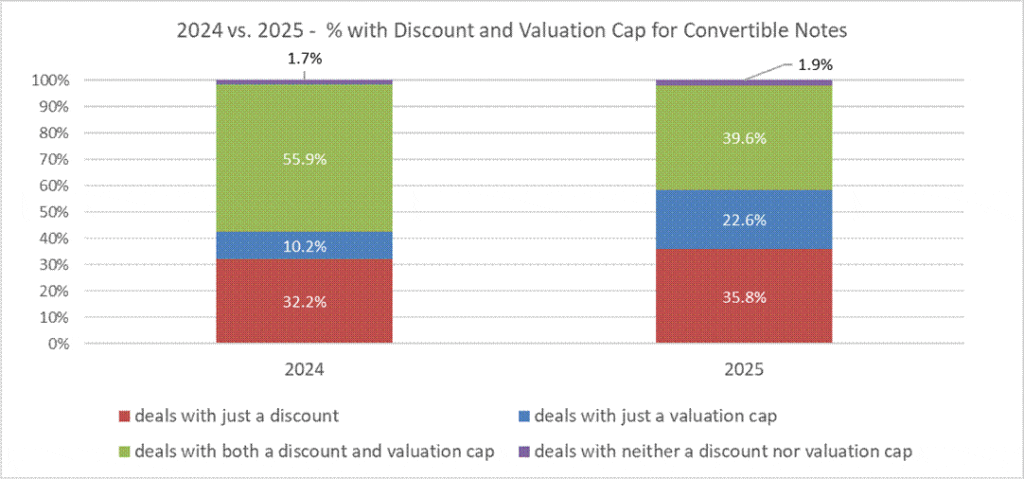
The proportion of SAFEs including both a discount and a valuation cap increased to 56.1% in 2025 from 47.9% in 2024, while the proportion of convertible promissory notes with both provisions decreased to 39.6% from 55.9% in 2024. This divergence suggests that SAFE investors are increasingly seeking layered downside protection through both mechanisms, while convertible promissory note investors may be accepting simpler structures in exchange for other terms such as interest accrual and maturity dates that specify a date on which amounts owing under the convertible promissory note are due and payable to the investor.
DP2025-59
DP2025-60
Interest Rates (Convertible Promissory Notes)
The chart below reflects the median and average interest rates for convertible promissory notes in 2024 and 2025.
In 2025, interest rates on convertible promissory notes remained broadly consistent with 2024, with a median rate of 8% in both years. The average interest rate decreased slightly from 8.1% in 2024 to 5.9% in 2025, suggesting marginally more favourable pricing for companies in the current market.
As described in the “Methodology and Background” section, this analysis is limited to transactions through to Series Seed (inclusive).
DP2025-61
Term (Convertible Promissory Note)
The chart below reflects the median and average term for convertible promissory notes in 2024 and 2025. For convertible promissory notes, a term is the period of time during which a convertible promissory note is outstanding before the borrower is required to repay the total principal and interest due under the convertible promissory note.
The median term for convertible promissory notes remained constant at 24 months in both 2024 and 2025, with the average term decreasing to 26.2 months in 2025 (compared to 27.7 months in 2024).
As described in the “Methodology and Background” section, this analysis is limited to transactions through Series Seed (inclusive).
DP2025-62
Discounts Rates (SAFEs and Convertible Promissory Notes)
The chart below reflects the median and average discount rates for SAFEs and Convertible promissory notes issued in 2024 and 2025. A discount rate is relevant in that it determines the price per share of the issuer (and therefore the number of shares of the issuer) that the purchase amount of a SAFE or Convertible promissory note converts into in connection with a conversion event – this price will be at a “discount” to the price per share ascribed to new shares issued by the issuer in connection with a conversion event. In some cases, SAFEs and Convertible promissory notes may have both a discount and a valuation cap (discussed further below) that each determine a price per share of the issuer (and therefore the number of shares of the issuer) that the purchase amount of a SAFE or Convertible promissory note converts into in connection with a conversion event – in those circumstances, the holder’s applicable price per share would be the lower of the discount price and the valuation cap price.
The median discount rate remained constant at 20% for both convertible promissory notes and SAFEs across 2024 and 2025, but average rates showed slightly divergent trends. For convertible promissory notes, the average discount increased from 20.2% in 2024 to 23.5% in 2025, while SAFEs showed a tightening range with the average decreasing from 20.4% in 2024 to 18.4% in 2025.
As described in the “Methodology and Background” section, this analysis is limited to transactions through Series Seed (inclusive).
DP2025-63
Valuation Caps by Series (Convertible Promissory Note)
The chart below reflects the median and average valuation caps for Convertible promissory notes issued in 2024 and 2025. A valuation cap is relevant in that it determines the price per share of the issuer (and therefore the number of shares of the issuer) that the principal amount and interest of a Convertible promissory note converts into in connection with a conversion event – this price will be at a maximum “capped valuation” notwithstanding the valuation ascribed to the new shares issued by the issuer in connection with a conversion event. As discussed above, Convertible promissory notes can have both a valuation cap and a discount. This concept applies equally to a SAFE, where the SAFE in question includes a valuation cap.
The valuation cap data for convertible promissory notes in 2025 shows significant increases in median valuation caps at the pre-Seed stage. For companies with no prior financing, the median valuation cap increased from approximately $5.1M in 2024 to $7.0M in 2025.
As described in the “Methodology and Background” section, this analysis is limited to transactions through Series Seed (inclusive).
DP2025-64
Valuation Caps by Series (SAFE)
The chart below reflects the median and average valuation caps for SAFEs issued in 2024 and 2025, by series.
For SAFEs issued in 2025, median valuation caps increased at the pre-Seed and post-Seed stages of financing, reflecting continued upward momentum on valuations. The median valuation cap for companies with no prior financing increased to approximately $10.5M from $7.5M in 2024, and companies at the Seed stage saw median valuation caps of $23.0M (compared to $15.3M in 2024). At the same time, average valuation caps grew at the pre-Seed stage between 2024 and 2025, while the average valuation caps for post-Seed stage companies dropped marginally between 2024 and 2025.
As described in the “Methodology and Background” section, this analysis is limited to transactions through Series A (inclusive).
DP2025-65
Acknowledgment
We gratefully acknowledge the help of our Osler Works – Transactional (OWT) team, in particular Natalie Munroe and Oren Kedmi, and our Business Analytics specialists, Andrey Serdyukov and Diana Lau – whose contributions were critical to the completion of this report. We also wish to thank Jacques Du Plessis, a Partner in Osler’s Emerging and High Growth Companies Group, based in Vancouver, who took the lead in preparing the data and narratives for the Convertible Securities Intelligence section of this year’s Deal Points Report.
A conversation with Curt Sigfstead of Clio
Osler clients share their success stories.
Watch the interview
Osler’s Emerging and High Growth Companies Group
We support companies through the stages of their lifecycle, providing legal advice on a wide range of issues.
